Sunday, 23 September 2012

Prison manpower

British Justice Secretary Ken Clarke recently decided that the “feral underclass” overcrowding the country’s prisons should “get off their beds and into purposeful activity”. Prisoners are a wasted resource, he says, “thousands of hours of manpower lying idle,” and they should be working 40 hours a week. In short, prisons are not “delivering as they should”.


So, how should prisons deliver?
The prisoner-employment initiative was pioneered in the UK by shoe-repair and key-cutting chain Timpsons, which trains and employs prisoners in its shops. Other jobs done by prisoners include  construction, sewing, farm, welding, plastering, motor mechanics, printing, manufacture of military equipment, and training guide dogs. Much of the work for the prison itself which would otherwise have to be outsourced to private contractors, such as making prison furniture and uniforms, can be done by inmates.

Why should prisoners work?
Part of the rationale for obliging prisoners to work is that it helps instil a work ethic in them. It gets them into the routine of getting up every morning, putting in a day of productivity, and feeling they have achieved something at the end of the day. This stands them in good stead when they leave prison, because they are more likely to find a job (especially if they have learnt new skills as part of their work) and keep it, and less likely to return to a life of crime.

The system is working well at one prison where all inmates work and also have access to courses such as motor mechanics and literacy. 57% of them go into employment or further training or education after their release, which is 70% higher than the national average.

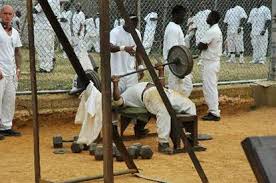
Working in prison also keeps prisoners occupied. As a prison official, you do not want bored inmates, because they will be tempted to fill their time by causing disruption. (For the same reason, prison officials and sociologists criticised the prohibition on weights in many US prisons. Weights were banned because muscly prisoners make guards nervous and because weights can be used as weapons. However, in practice, weight-lifting gives inmates something to do and keeps them out of trouble.)

So having prisoners work is good for the prisoners and good for society. But it is also good for employers. This site puts it best:

“For business moguls who have participated in prison labor schemes, it is like they continuously hit the lottery. The workers are unable to strike, there is no need to pay unemployment insurance. There is no need to cover vacation pay or workman's compensation bills. The workers pull full-time shifts, they never arrive late for work. They also never call in absent due to family emergencies. Even better than all this is that if the workers are not happy with their twenty five cents an hour, they can be locked up in secluded cells.”

But on the other hand…
But wait! the cry goes up. We are in the depths of a recession. Well-behaved, law-abiding, highly qualified citizens desperate to work can’t find employment – and yet prisoners are to be handed jobs on a silver platter! Employment is a privilege, and being in prison is – or should be – about having privileges taken away. Especially if the privilege deprives somebody else of a job – somebody whose taxes are going towards prisoners’ upkeep.

Prison labour is also a form of exploitation. In the words of US academics Steve Fraser and Joshua Freeman, “Rarely can you find workers so pliable, easy to control, stripped of political rights, and subject to martial discipline at the first sign of recalcitrance.”

THE WAGE ISSUE

Should working prisoners be paid market wages?
Currently prisoners are paid only a fraction of the usual going rate, sometimes as little as£0.40 per hour. (The national minimum wage is £6.08 per hour).

Advantages of paying prisoners at market rate
One concern about paying these low wages is that it does little to demonstrate the value of work. How motivated would you be to work if you were earning 6% of the minimum wage? Paying prisoners properly helps instill in them an understanding of the satisfaction and usefulness of earning their own money, and inspires them to look for employment after being released rather than turning back to crime to survive.

As one vociferous politician whose name I cannot recall vented so eloquently on the radio, “Many of these people are in prison because they’ve never worked a day in their lives. And if they work in prison and get paid miserably, they will see that they were right not to work!”

In addition, proper wages will help a prisoner support his family while he is in prison and to save up so that does not become a burden on the taxpayer when he is released and is setting up a new life.

Insisting on market wages for prisoners also helps protect other workers and job-seekers, since employers often favour the cheap labour of prisoners over the market-rate labour of law-abiding citizens. (Some companies have brought their outsourced services back from India to the UK to be done by prisoners, and some have even fired their own workers or pressurised them to quit to make way for prisoners.) 


But on the other hand…
As mentioned above, employment itself is a privilege, and good wages even more so. If you have broken the law, why should you be rewarded for it by being given a well-paid job?

GMB union leader Paul Kenny’s take on the matter is: “Ken Clarke has taken leave of his senses. There are 2 million people on the dole looking for work and the idea of bypassing them and undermining the national minimum wage is frankly ludicrous and unacceptable.” 

One solution to the wage issue
One way round the problem is to pay prisoners market wages, but allow them access to only a fraction of the money while they are serving their sentence. The rest can be set aside for when they are released.


Is prison life really as good as Ken Clarke would have us believe?
I was once talking to someone who had worked in a British prison, and he painted a picture of a fairly luxurious place: TV, gym facilities, a library, very few responsibilities.
“But what’s the punishment then?” I asked.
“The punishment,” he informed me gravely, “is the complete loss of liberty. You’re trapped there.”

Final thought
One thing that strikes me is that it is easy to draw an “Us and Them” line between prisoners and the general population. “They’re not like us,” we tell ourselves. “They’re a different type of person.” But they’re not. You don’t have to be a particular type of person to go to prison. It can happen to anyone, including you.

Here are some of the ways you too could become a prisoner:

For up to 2 years imprisonment:
Falsely describing or presenting food
Making off without payment

Up to 3 years:
Presentation of an obscene performance of a play

Up to 5 years:
Abstracting of electricity

Up to 7 years:
False accounting
Insider trading
Communicating false information alleging the presence of bombs
Placing or dispatching articles to cause a bomb hoax
Bigamy

Up to 10 years:
Making threats to kill

Up to 14 years:
Fraudulently printing, mutilating or re-issuing stamps

Life:
Offences which amount to the crime of piracy under the Piracy Acts 1698 and 1721
And finally – and I can’t believe this actually happens – impeding a person endeavouring to save himself from shipwreck

Now just tell me you’ve never at least thought about doing one of the acts above. And if you really haven’t, then I bet you know somebody who has. Just the other day a friend of mine “made off without payment”. She walked out of the hairdresser’s salon completely forgetting to pay for her cut and blowdry. (She phoned the hairdresser later when she realised it. “Why didn’t you say anything?” she asked. “I didn’t know what to say,” he replied. Quite.) Or “an obscene performance of a play”. I saw a performance of Shakespeare’s Tempest once where the actress playing Ariel was topless throughout. And I myself regularly “falsely describe or present food” (“It’s supposed to be that colour. Eat it.”)

You’re just lucky because you’ve never been caught for doing these deviant things. But next time you might be. And then you could become a prisoner too, and that “Us and Them” line will not seem quite so substantial anymore.

I leave you with the immortal words from the film Blow, the story of George Jung, cocaine smuggler, who is currently serving a 20-year sentence:


SOURCES
http://weeklywire.com/ww/04-24-00/boston_feature_2.html

Sunday, 2 September 2012

In search of the anti-rabbit

While working on a translation the other day, I happened to need to know what preposition the verb “to be constituted” takes (and don’t sit there looking so smug: do you know what preposition it takes?). Google, normally the fount of all knowledge, was uncharacteristically unhelpful with the matter, so I turned to the European Union’s online multilingual dictionary, IATE, where I typed in “costituito” (the Italian term that had thrown me) and got the shock of my life to be faced with this:

Chimica []Voce completa
IT
coniugato costituito da immunoglobulina anti-coniglio e isotiocianato di fluoresceina
FITC
EN
FITC
fluorescein isothiocyanate anti-rabbit immunoglobulin conjugate

In the midst of this lexical kaleidoscope, the only words that really swam into focus were “anti-rabbit”. So I decided to work with what I had and googled anti-rabbit. It turns out to be a term from the field of antibodies. And I was left well and truly speechless to discover, fourteen and a half million results later, that antibodies can be not only anti-rabbit but also anti-goat, anti-horse, anti-mouse, anti-rat, anti-sheep, anti-pig, anti-chicken, anti-donkey, anti-guinea-pig, anti-hamster and anti-cow (which is actually properly called anti-bovine). 

And it gets worse. Antibodies can also be goat anti-mouse, chicken anti-rat, donkey anti-pig, and all manner of startling combinations of animals.

But what does it all mean?
  
1)      Let’s start with immunoglobulin, which is another word for antibody.
An antibody (or immunoglobulin if you prefer) is a type of protein which functions within the immune system to identify and neutralise antigens.  They are produced by plasma cells, a type of white blood cell.

2)      What is an antigen?
An antigen is a foreign body which an antibody attacks.  Examples of antigens are microorganisms (e.g. bacteria, viruses, funghi and parasites), pollen, chemicals, bacterial toxins and tissue cells.

3)      What does an antibody look like?
An antibody looks like this:
but for the sake of comprehension, we will picture it like this:


It is made up of two heavy polypeptide chains (blue) and two light ones (pink) arranged in a Y shape.  For the most part, antibodies are all the same except for the tips of the Y (the light areas in the picture). These tips are the antigen binding sites – the parts of the antibody which attach themselves to the antigen, and they differ according to which antigen they bind to.

4)      What does an antibody do to an antigen?
An antibody has various methods of attack:

a)      Opsonisation
The antibody recognises and attaches itself to an antigen, then releases a chemical signal to attract phagocytic (devouring) cells to consume it.

b)      Neutralisation
Sometimes the antibody also neutralises the antigen directly by attaching itself to the part of the antigen that is used to cause infection, rendering it useless.

c)       Complement activation
The antibody calls phagocytic cells, and while it waits for them to arrive, it activates complement, a chain of proteins which helps destroy infected cells.

d)      Agglutination
Having two branches in its Y shape, the antibody can bind to two antigens.  So an antibody can join two antigens together, then another antibody can join another antigen to them, and so on, until a clump is formed. This clump becomes cumbersome and vulnerable to phagocytes.

An animation of neutralisation and opsonisation:


5)      Isn’t that amazing?
It is – when it works. But sometimes it doesn’t. Some immune disorders, for example, prevent the immune system producing the right antibodies or enough of them. Or with cancer, your immune system may not recognise the cancer cells as dangerous, because they are relatively similar to your body cells. Alternatively, it may recognise them as foreign but not be strong enough to fight them, or the immune system’s activity might be limited by substances given off by the cancer cells.

6)      Are we getting to the rabbits now?
Yes. Cases such as those described above can be treated by introducing foreign antibodies into the body. These antibodies are created in a laboratory by injecting animals with the antigen in question, inducing them to produce the appropriate antibodies. Mice are the animals most frequently used, but rabbits – and indeed goats, horses, rats, sheep, pigs, chickens, donkeys, guinea pigs, hamsters and cows – can also be used.

This is a clever idea in theory, but in practice, your body sometimes feels threatened by these foreign antibodies, and manufactures its own antibodies to attack them, producing an allergic reaction which can range from a rash to renal failure. These antibodies which you produce are called anti-mouse antibodies (or anti-rabbit or anti-chicken, or anti- whatever the animal in question is). And because you are human, they are called human anti-mouse (or human anti-chicken etc) antibodies. If you were a goat, the result would be goat anti-mouse antibodies. You get the idea.

Animals in our systems are not as infrequent as you might think. It is estimated that at least 10% of the general population carries some form of animal-derived antibodies, due to the widespread use of medicines manufactured using animal sera.

7)      Now we need to deal with fluorescein isothiocyanate. Stay with me…
Fluorescein is a dye which glows (“to fluoresce” means “to glow”), and it is used as a tracer (being introduced into a body or other system so that its distribution can be followed).

Isothiocyanates are a family of organic compounds, which are found in nature in certain strongly-flavoured vegetables such as horseradish and onions. (“Iso”=similar, “thio”=sulphur, “cyanate”=salt or ester of cyanic acid)These compounds can be synthesised, however, from, among other things, the fluorescein mentioned above.

Fluorescein isothiocyanate – the organic compound synthesised from fluorescein – is used to label and track cells, so that they can be identified under a microscope. It can be conjugated (connected) to antibodies, which help target specific proteins or structures (remember, antibodies are all about targeting: watch the video above again if you don’t remember).

8)      So in summary:
Fluorescein isothiocyanate anti-rabbit immunoglobulin conjugate need scare us no longer. We now know that it is an organic compound (isothiocyanate) derived from a fluorescing dye (fluorescein), connected (conjugated) to an antibody (immunoglobulin) which fights antibodies produced in rabbits (anti-rabbit).

9)      Where can I get it?
From Sigma Aldrich, purveyors of chemical and biochemical products. They advise you to store your fluorescein isothiocyanate anti-rabbit immunoglobulin conjugate as follows:

For continuous use, store at 2-8 °C for up to one month. For extended storage, the solution may be frozen in working aliquots.  Repeated freezing and thawing is not recommended.  Storage in "frost-free" freezers is not recommended.  If slight turbidity occurs upon prolonged storage, clarify the solution by centrifugation before use.

10)   And since you were probably wondering…
“Constituted by” and “constituted of” both exist. I went for “by” on this occasion.

SOURCES 


Sunday, 26 August 2012

People and their stories


It’s a remarkable thing, I think, that there are over seven billion people in the world, and yet each one of them is significant. Often, I look at someone in the street and think, “You mean nothing to me. I wasn’t even aware of your existence until a moment ago, and in another moment’s time, I will have forgotten you. But from where you are standing, you are the most important person in the world.”
                                                                               
Sometimes I’m tempted to go up to people and demand, “What’s your story?”

Here are some of the people I have seen recently, all of whom have a story that I don’t know about:

1)      CONCERNED WOMAN

A lady and a gentleman of fairly advanced years were walking down the road. The gentleman was dressed in a jacket and tie, and the lady was dressed in an unflattering but formal dress. It was Sunday, so perhaps they were coming from or going to church. Suddenly, the woman stopped, swung round, glared at something on the ground behind her, and then carried on walking.

What had she seen?

2)      SUPERHEROES

This was one story I managed to resolve. I was having coffee with a friend in the city centre, when I saw a flash of blue and red out of the corner of my eye. I looked up, and there was Superman swooping off down the road, flanked by Batman and the Incredible Hulk.
We leapt up and ran after them.
“Hey!” we said. “What are you doing here?”
They beamed at us. “We’re recruiting,” they said. They went on to rattle off a litany of information regarding wages, hours, benefits and much else, without ever making it clear precisely what they were recruiting for, nor why the recruiting had to be done by superheroes.

But who was saving the world while all this was going on?  

3)      EMBRYONIC FOOTBALLER

The Janiculum Hill is one of the most enchanting places in Rome, with its magnificent views of the city and the feeling of tranquillity even so close to the pandemonium that is Rome city centre.

Two families were standing around chatting there, while their two little boys, who were in the initial stages of learning to walk upright, toddled around at their feet. Then one of the parents gave the little boys a ball. One child attempted to pick the ball up, but was thwarted by insufficient motor skills. The other staggered over, with that curious gait that toddlers have when they attempt to run, and gave the ball a determined kick, quite as if he were a professional footballer.

How does a child who probably can’t even say the word “football” yet know that a ball is to be kicked?


4)      MELON MAN

A man, unshaven, dirty and probably homeless, was sitting on a low step next to the pavement. He was devouring a melon, tearing it apart with his bare hands.
“I could judge him for eating like an animal,” I thought, “but I’m not the one who’s living on the street. If you don’t have enough to eat, table manners are probably not top on your list of concerns.”
That is what made me think that “culture” is a luxury not to be taken for granted in our society, since it is very much dependent on quality of life.

Had the man always been in such miserable conditions? If not, what had happened to lead up to this moment?

5)      MOLE CHILD

I passed a family going for an evening stroll.
“Excuse me, Daddy,” cried out the son, who must have been about six, in an imperious tone. “Where do moles live?”
“Underground,” the father replied.
“No, no,” said the boy, shaking his head. “I mean what region do they live in?”
“Lots of different regions,” replied the father, probably a little unsatisfactorily.

Why would a child find it so important to know in which parts of the country moles could be found?

6)      SPECTATOR SPORT

In the little hilltop town where I lived for a while, a group of old men would gather on the side of the road every evening – not outside a bar, as might be expected, but just outside a nondescript building. They would line up and lean against the railings, and wait for the bus to come past. Then they would raise their eyebrows at the driver.

Why did they stand at that particular spot? And what did they do for the rest of the day when they weren’t standing there? And did they know all the bus drivers personally?

7)      PINK LEOPARDSKIN GIRL

Outside a university, a girl dressed from top to toe in pink leopardskin – shoes, socks, miniskirt, crop top and headband – was dancing to a song blaring out from a CD player on the ground. At first I took her for a busker, but then saw there was no receptacle for money in front of her. I put it down to the popularity of arts degrees.

What was she trying to achieve and why? And, more importantly, where did she get all the pink leopardskin?

8)      TRUCK MOTHER

Crossing the road, I had to stop to let a lorry go by. This was not in itself unusual, but then I looked at the driver. It was a pretty, blonde young woman – and next to her was a booster seat containing a small child.

Where was she going in that massive vehicle? If she was working, then how did she end up in such a traditionally male job? And if she was just going out to do the grocery shopping, then why was she driving such a cumbersome vehicle?

9)      TORTOISE LADY

In another little hilltop town, there was an upstairs window looking out onto a little square. The shutters were always closed, no matter how glorious the day might be outside. Every day at about 5pm, an elderly lady opened one shutter a few centimetres. Clutching onto the underside of the shutter, she would peep out. She would stay there for about ten minutes, just watching people going past outside, and then withdraw once more, like a tortoise into its shell, and barricade herself in again.

Why did she keep the shutters closed? And what did she do once she went back inside?

10)  ORANGE BOY

A teenage boy used to get the bus with me every morning.  And he was always wearing orange.

Was he aware that his wardrobe was entirely orange, or did he just pick clothes that he liked, without realising that they were the same colour as everything else in his wardrobe?

11)  BEACH VENDOR

There were men walking up and down the beach selling bags, clothes and jewellery. One man stopped to try and sell a purse to my friend and me.
“It’s the first time I’ve done this work,” he told us. “In my country, in Bangladesh, I’m a nurse, but I couldn’t find work there, so I came to Italy. My wife came to Italy before me, but she’s in another city, and I don’t see her very often. I want to do a course to requalify, so I can work as a nurse here, but it’s very expensive. So for the moment, I’m selling things on the beach. You’re my first customers.”

What kind of a life is that??? How many people leave their countries because life is impossibly hard, and go to Europe or to America or to some other place where they think everything will be idyllic, only to find themselves facing just as many hardships there? And how many people judge these immigrants, thinking of them as faceless, uneducated masses, without realising that many of them were professionals in their own countries and have shown admirable courage in starting a new life in a foreign environment?

Thursday, 2 August 2012

Pearls of wisdom


“Teacher,” my student informed me as he strode purposefully into the classroom one day after lunch, “I was reading a writer – an English-speaking writer called Mrs Rose.”
He looked at me expectantly.
I expressed my pleasure at his reading in English under his own steam, but this did not appear to satisfy him.
“You know this writer?” he demanded.
“I’m afraid I don’t,” I said.

He went on to catalogue the subjects that this writer had written about, periodically stopping to ask, “You really don’t know her?”  He went on for a good five minutes, and it wasn’t until he mentioned a “flower that looks like a bird of paradise” and a “picture of her grandparents” that I realised he was talking about this blog.

He told some of his classmates about it.
 “Are you going to write about us in your blog?” they wanted to know.
“Would you like me to?” I asked.
They were gratifyingly enthusiastic about the idea, so I set them loose with pens and scraps of paper.

What follows is the Collated Pearls of Wisdom Emerging from a Super-Intensive English Course in Central Italy, some in English, some in Italian, some in obscure regional dialects, and some in a dizzying combination of the above.
  
1) SMILE 
Stort va
Dritt ven
It goes crooked
It comes straight
(i.e. Negative things can become positive)

Nella vita ho imparato che dopo ogni tempesta c’è sempre una magnifica giornata di sole che ti riscalda il cuore e ti fa sorridere.
In life I have learnt that after every storm there is always a beautiful, sunny day which warms your heart and makes you smile.

You have smile, also if your smile is sad, because more sad of a smile, there is the gloominess of don't know how to smile. (Jim Morrison)

2) LEOPARDS DON'T CHANGE THEIR SPOTS
Chi nasc tun nun po’ murt quadrat
Someone who is born round cannot die square.
(i.e. People don’t change.)

3) WHAT HAPPENS WHEN YOU WORK IN HIGHLY RADIOACTIVE PLACES
Quando entro in una stanza non pigio l’interruttore, la luce si accende da sola.
When I go into a room, I don’t turn on the light at the switch. The light switches on by itself.

4) NEAPOLITAN TOAST
A chi male ce v’
E chiù faveze ce tratt’!
To the health of those who wish us ill and are deceptive towards us!

5) NEAPOLITAN MANNERS
"You know, in Naples, when they steal the wheels from your car, they leave a note on the windscreen saying 'Thank you'."
"Heh! The problem is when they steal your car. Then where do they leave the note?"


6) THE GENETIC MAKE-UP OF NEAPOLITANS
Il 75% è cazzimm. 
[Suggestions on a postcard, please.]

7) PRIORITIES
Non è tutto oro quello che luccica! La pietra più preziosa è quella che splende nel più profondo del cuore, l’indimenticabile ed immensa emozione di amare!
(All that glitters is not gold! The most precious stone is the one that shines deep within your heart, the unforgettable, immense emotion of love!)

8) MULTILINGUILISM 
"We Italians use our hands when we speak. We are helicopters. English people communicate with facial expressions."

9) THE PROBLEM WITH THE WORLD TODAY
I cellulari avvicinano le persone lontane e allontanano quelle vicine.
(Mobile phones bring people who are far away closer together, and move people who are close far apart.)

10) OPEN YOUR EYES 
Yesterday is past, tomorrow is a mystery, but today is a gift and for this reason it is called the present.

Nulla si crea, nulla si distrugge, tutto si trasforma. L’importante è conservare sempre il bambino che è in noi. Un uomo cessa infatti di essere tale nel momento in cui non si stupisce più non si meraviglia più.

(Nothing is created, nothing is destroyed, everything transforms. The most important thing is to always retain the child within us. A man stops being this as soon as he is no longer surprised and no longer feels wonder.)

11) APPARENT PARADOXES IN THE LAWS OF PHYSICS
Gli incontri di un attimo durano un’eternità.
(Brief meetings last forever.)


12) PUTTING THINGS IN PERSPECTIVE
Quello che non ti butta giù ti rende più forte. Quello che ti rende più forte ti migliora. Quello che ti migliora permette a gli altri di migliorarsi.
(What doesn’t kill you makes you stronger. What makes you stronger improves you. What improves you allows others to improve.)

Ci sono giorni che valgono tutta una vita e vite che pensi non valgano un solo giorno. Ma in ogni giorno c’è una vita intera.
(There are days that are worth a whole life and lives that you think aren’t worth a single day. But in every day there is an entire life.)

13) TIME TO TAKE A BREAK
Son pighiat la carn… Moo!!! S’ann pighia l’ossr.
(They've taken the meat… now they can only take the bones.)


14) ANATOMY LESSON
Tien a cap p’ spart’r i rrecchie
(Your head is only there to separate your ears.)

15) KNOW YOUR PLACE
Capo indiano (red skin) Il Dio che ha creato tutto questo è lo stesso Dio che ha creato l’uomo bianco e l’uomo rosso.
(Indian chief (red skin) The God that created all this is the same God that created white man and red man.)

16) BLOOD, SWEAT AND TEARS
Quando vuoi qualcosa, la devi cercare, la devi inseguire e non devi mai mollarla…
(When you want something, you must seek it, you must follow it and you must never let go of it…)

17) BLOOD IS THICKER THAN FIANO DI AVELLINO, DOCG, VINTAGE 2005
Il mondo è paese
La famiglia è il mondo.
(The world is a single country
The family is the world.)

Chi ha avut avut avut
Chi ha rat ha rat ha rat
Scurdamm’c o’ passato
Simm e Napol paisà
(Whoever has had or given, let’s forget everything; we are all from Naples.)

Tale mamma
Tale figlia
(Like mother like daughter.)

18) YOUR GUESS IS AS GOOD AS MINE
Jo cannarizzo stritto stritto sé gnotte la casa co’ tutto titto.
Tra cici cicerchi i lenticchie i mejo legumi so le zazzicchie
The contributor of this pearl of wisdom flatly refused to supply an explanation, insisting that it can be neither translated nor explained; indeed that it has no independent existence outside its native dialect. Truth be told, I don't even know if it's one pearl of wisdom or two. It didn't even come up in a Google search.

19) AND MY COLLEAGUES SAY:
Always remember that God only helps who helps himself/herself.

Believe in your destiny and always go forward.

A man is 3 things:
1)      What he thinks he is
2)      What his friends think he is
3)      What he really is
Think about it!

And think we shall. Thank you to my guest contributors. If I've made any mistakes with the dialects, feel free to let me know.