Tuesday, 4 March 2014

Impromptu tourism

It’s always somewhat painful when the alarm goes off at 6 in the morning, especially in winter. It’s dark, it’s cold, it’s an unnatural time to be out in the world.

This trauma is thankfully no more than a weekly occurrence for me. On Monday mornings I voyage forth to teach at a university out in the back of beyond, way outside the self-contained world that is Paris. Once I get there, things generally go swimmingly, but the process of getting there can require superhuman effort.

When I arrived at work last Monday, having gone through the requisite trauma, I went to the reception to pick up my registers and was received by a blank look from the receptionist, followed by a little noise of astonishment.
“What are you doing here?” she demanded. “There are no lessons this week!”
“Oh,” I said, since there was very little else I could say under the circumstances.
It turns out that the university had a week’s break, but since I just bungee in and bungee back out once a week, I’m not really very plugged into the system and don’t particularly keep track of incidental information like holiday dates.

So finding myself with an unexpectedly free day, I wished the receptionist well and wandered back to the metro station, where I looked in quiet amusement at all the people who had just dragged themselves out of bed (I had by this point been awake for two hours) and who were lumbering off to start a day of work. 

There were some parks that I had been planning to visit for some time but I always got too carried away with daily routine to do so. But now with my daily routine interrupted, it was a perfect opportunity to go and tick some parks off my list.  

I left the sleepy people on the metro and went to have a wander round Parc Kellerman, where I watched ducks having breakfast and gardeners sweeping paths as well as the odd disturbingly enthusiastic jogger plodding their way among the trees.
I pressed on with a scenic walk through the Jardin Thomire and past the Charléty stadium, to Parc Montsouris. I had a moment of déjà vu and then realised that I had been there five years ago one a visit to Paris. Crocuses were pushing up through the grass, announcing the arrival of spring, and a Chinese man was doing tai chi among the trees.
Suitably uplifted, I got on the train and headed towards the city centre to the Jardin de Luxembourg. People were walking dogs, joggers were out in full force and a man was sitting on a bench brushing his teeth. In the background, the Montparnasse Tower disappeared up into the clouds.

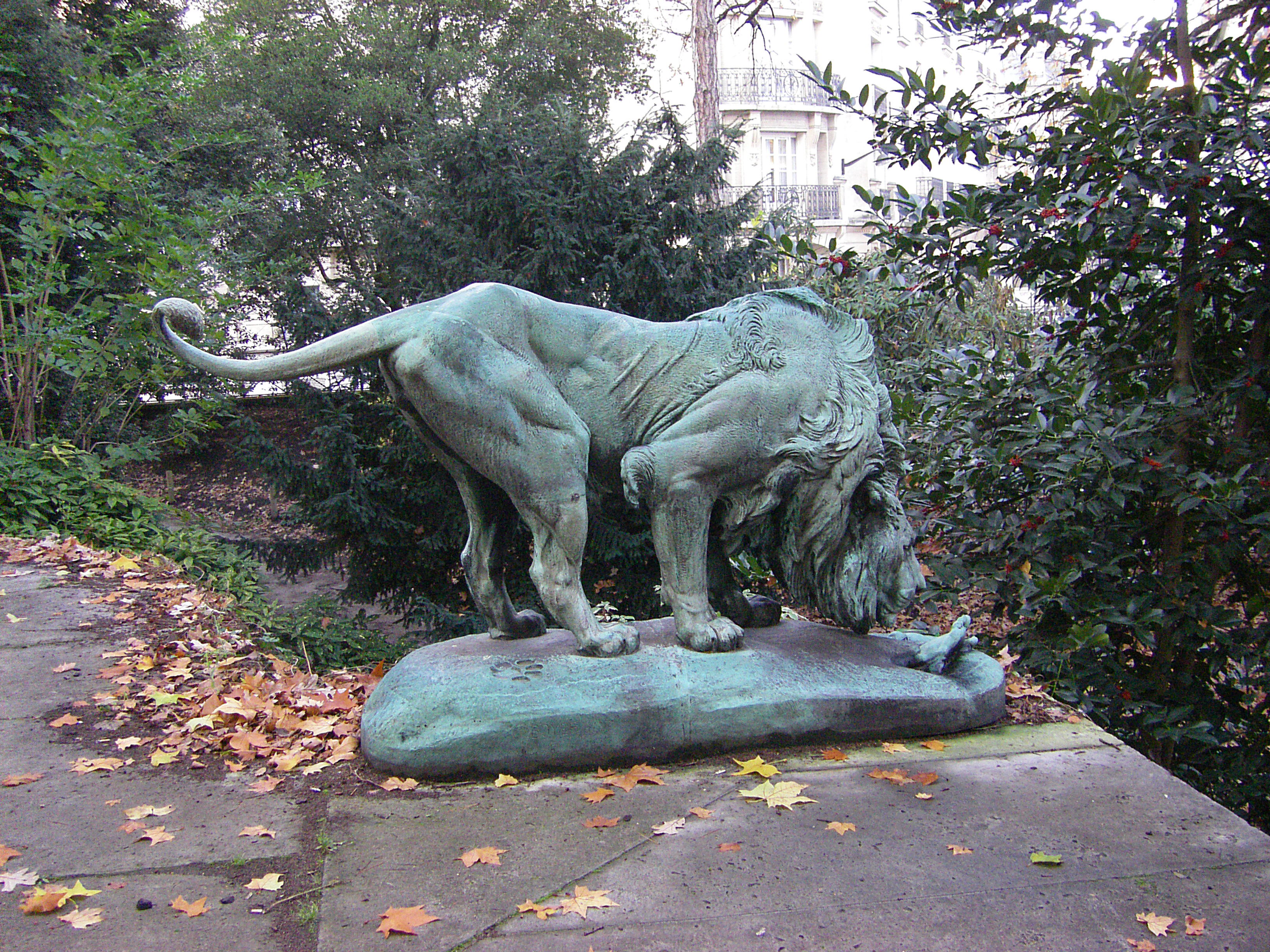
From there I headed for the Jardin des Plantes, where a slope had become eroded, exposing a tree’s roots, and a statue of a lion was eating what was left of a person, which was just a foot.

The Jardin des Plantes is home to the natural history museum, which had a magnificent exhibition on called Nuit, which dealt with all things nocturnal.

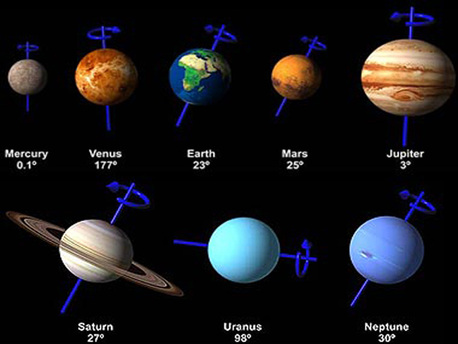
The first section of the exhibition was about the night sky – the moon, the stars, the planets. In this section I was most suprised to learn that the planets in our solar system all spin on very different axes. How did I get this far without knowing that? Uranus has somehow turned onto its side, and Venus has tilted so far that its top and bottom are entirely reversed. 

I also learned how tides work, which was another shameful gap in my general knowledge. Everyone knows that the moon pulls on the sea, making it rise on the side of the earth closest to the moon. But did you know that the moon and Earth create a centrifugal system as they rotate round each other? And that centrifugal system sends the water on the side of the Earth opposite the moon swinging outwards? So the ocean on one side of Earth is being flung outwards by centrifugal force and on the other side it’s being pulled by the moon, which is why the tide is high on opposite sides of the Earth at the same time.

I also found out that on 10 August 2014 the moon will be at its closest point to the Earth, and will be quite magnificent. Put it in your diary.

There was this video display (happily also available on YouTube) on the relative sizes of various celestial bodies, which was possibly the most intimidating thing I’ve ever seen.

I watched it through four times and came away with shaking knees and a crushing sense of insignificance, and went to seek solace among the creatures of the night.

The animals were beautiful and it was slightly awkward to think that they were probably going about their nocturnal business quite contentedly before someone put a bullet through them and dragged them off to be preserved, stuffed and placed in a display, but I swept that niggling thought under my mental carpet and marvelled at the stern stare of owls, the deer caught mid-step, the grey goose suspended in flight and the wolf pricking up its ears at a sound in the underbrush.


It’s an incredible skill, taxidermy. How do you take the lifeless carcass of an animal, preserve it and then arrange it in such a way – limb positions, attitude, even facial expressions – that it looks as if it has been suddenly frozen while going about its regular business?

There was a very interesting display on the sense of smell (included in the exhibition because some animals use smell to guide them when there is little light), including some delightful pictures of animals flehmening - drawing back the top lip and inhaling to better analyse an odour.


There was also a display of the most incredible insects which mimicked leaves so convincingly that even knowing that they were insects, I was unable to see their wings for wings and could only see them as leaves.

Following a very cute array of diurnal animals bedding down for the night, there were some information sheets about dreaming, from which I learned that the reason we forget our dreams so quickly is that the part of the brain that deals with memory is not activated during dreaming.

Then there was a frilly pastel-coloured, carpeted room made to suggest a bedroom, with some blurbs about monsters under the bed and a Pixaresque animation on the subject, followed by a slightly incongruous display cabinet full of vampire memorabilia and an inexplicable room, empty but for two sumptuous-looking chairs, with a curtain over the entrance, and a shadow display that didn’t work. The shadow display was set up in a grey concrete corridor which terminated in a set of stairs that emerged out by the ticket office.

And that was the night exhibition.

I was by this point tired and hungry, and although I had enjoyed the exhibition very much, I was quite ready for lunch. But my ticket gave me access to the permanent exhibition, and I thought it would be a pity to waste it, so I went and had a quick nose round upstairs.

I was glad I had because the first thing you see when you go into the permanent exhibition is an entire whale skeleton suspended from the ceiling. I had been thinking about whales just the day before and wondering if I would ever be able to see one. It remains on my bucket list, but the skeleton went some way towards satisfying my curiosity. 


SO, WHAT HAVE WE LEARNT?

1) Those early mornings never get any easier...
2) ...but they can turn out to be worth it
3) Some people go jogging early in the morning
4) Spring is coming!
5) The axes of our neighbouring planets are a lot more irregular than you might expect
6) On one side of the Earth, the sea is pulled by the moon, while on the other side it is flung outwards by centrifugal force. That's why there are high tides on opposite sides of the world at the same time. 
7) Look at the moon on 10 August 2014. 
8) Stars are terrifyingly huge
9) It's almost impossible to remember your dreams. 
10) Check the permanent exhibition before you go for lunch. There might be something  worthwhile in it. 

Wednesday, 29 January 2014

Mother knows best

When I was little I used to ask my mother all sorts of questions about the world. She was the fount of all knowledge and it never occurred to me that she might not know the answer to a question. 

Things haven't changed much now that I'm all grown up. I still expect my mother to know the answer to everything. The only thing that has changed is the kind of question I ask. Where it used to be "Mom, what's under the floorboards?" (The foundations of the house - and lots of spiders) or "Why do dogs eat grass?" (It's their vegetables) or "Look at this green stone I found! Do you think it's an emerald?" (No, darling, I think it's a piece of green glass), I now ask infinitely duller questions like "Mom, do you think I can contest this parking ticket?" and "How do you go about choosing a pension plan?" and "Why has Microsoft Excel changed this list of numbers into obscure formulas?"

And she still always has the answer. 

Calvin's dad says that fathers get a book. I think mothers get one too. 

This is what it says in my mother's book: 

1. Do you have a tissue in your pocket?


2. Do you have your keys?

3. Don’t get ahead of yourself. Just take it one step at a time.

4. I'm just going to let this one ride. I've learnt in life that you have to choose your battles carefully.


5. A year from now, will it still matter? (And if it won't, then there's no need to get stressed over it now.)

6. Don’t wear yourself out. It’s much more productive to have a rest and recharge, then continue later.

7. Hey – where did you learn to eat without laying the table properly first?!


8. Why are you sitting in here with all the windows closed?

9. I need to tidy up here before I get down to work. I can’t concentrate with all this clutter lying around.

10. What’s mine, my darling, is yours.

11. Networking, sweetheart, networking! 


And once you've made contacts, you have to groom them. 

12. Insomnia is when you are lying in bed with your eyes closed and sleep doesn’t come. Sitting in front of the computer reading Wikipedia at 3 in the morning isn’t insomnia.


13. Don’t you think you should have something to eat before you go out? No, not a biscuit, I mean proper food.

14. Now, let’s be organised about this.


15. Write yourself a list.


16. Take a pen from the cupboard in the hall – there’s a whole pack of them there. There are also paper clips, rubber bands, bottles of Tipp-ex, rolls of Sellotape, and all manner of things that are just there and have always been there and will always been there.

17. Come on, focus!


18. Sometimes you can tell just by looking at people what they are thinking.


19. You can roll your eyes all you like, but what I’m telling you comes from the lofty heights of experience.


20. You may not understand now but one day you’ll understand.


21. Never volunteer information. If they need additional information they will ask for it.


22. You must put moisturiser on your face. Because otherwise when you are 40 you will look like a dried-up old prune, and you will come to me and say, “I wish I had used moisturiser”, and I’ll be so upset and I won’t be able to do anything about it. But I can do something about it now, so I’m telling you, please use moisturiser.


23. I have no patience with the way children are mollycoddled and indulged at school now. In my day, there were none of these games and fun activities and brightly-coloured textbooks with pictures on every page. We sat quietly, you listened to the lesson, and we didn’t give the teacher any nonsense. And we learned.


24. No, I didn’t drink the cup of tea, but it was nice to have it sitting there.


25. Of course I’m ready for my trip next week. My suitcase has been packed and waiting at the door for the last two weeks.


26. There's time to do anything, but always at the expense of something else. 


27. I’m doing it like baking a cake. (When my mother bakes a cake, she puts the flour and sugar out on the kitchen counter one day and the butter and eggs the next day, then the following day she mixes everything , she bakes it the day after that, and ices it the day after that. It takes a week to make a cake, one step at a time.)


27. Tomorrow is another day.


Friday, 3 January 2014

Wishing you well

One of the things you learn in France is how to wish everyone well. French people are very keen that everyone around them should be constantly enjoying themselves. You can tell this by the way they end their conversations:

“Well, goodbye and bonne journée” (Have a good day).
“Thank you very much. Bonne soirée.” (Have a good evening.)
“Well, I’m done for the week. Bon week-end.” (Have a good weekend.)
"Bon week-end à tous !"
A French person worth their salt wouldn’t dream of finishing a conversation without wishing their interlocutor a good something – a good day, a good evening, a good weekend, good holidays, a good journey home, etc. If there isn’t an immediately obvious good something to wish, the speaker will go into a slight panic, scrabbling around for a solution.
“Well, have a good… have a good… have a good… rest of the… time… until we see each other again,” they will force out, hovering nervously by the door, unable to leave until they have finished the sentence.

It’s a remarkably contagious habit. Although it is not really a feature of anglophone culture, English speakers are influenced startlingly quickly when they arrive in France. They may never have wished anyone so much as a good day in their lives, but within days of arriving in France, they are spouting “bon après-midi”, “bonne fin de journée” and “bonne semaine” with the best of them. It becomes so ingrained that English-speakers start using it on each other, and sometimes end up tying themselves into terrible knots when English simply doesn’t have an appropriate equivalent expression:
“OK, um, well, have a good what’s left of the day” or “So, enjoy the, um, the time until I next see you.”


To be sure, we in the English-speaking world do wish people well on occasion – “Have a good weekend” is heard frequently enough – but the difference between us and the French is the sheer variety, not to mention the unexpectedness, of some of the wishes.

The ticket-seller at the cinema hopes that you enjoy the film: “Bonne séance!”  she says as you walk off clutching your ticket.
The waiter in the restaurant hopes you enjoy the meal: “Bonne dégustation!” he says, as he places the dish in front of you.
Your friend hopes that you enjoy your journey home after visiting her: “Bonne route!” she says as she waves you off.
Your housemate hopes you enjoy preparing dinner. "Bonne cuisine!" he nods as he wanders into the kitchen to find you chopping onions.
Your colleague hopes you enjoy reading the document he has just given you: “Bonne lecture!” he says as he places it in your hand.
And my personal favourite: the girl working at the fitting rooms in the clothes shop hopes you enjoy trying on the clothes:  “Bonne essayage!” she says as she indicates a cubicle.


The list goes on. When someone is about to start a day of hard work, you wish them bon courage. If the work is not too hard but is work nevertheless, you simply wish them bon travail. As your colleagues announce they have had enough for the morning and they’re off to find some lunch, you wish them bon appétit. When you say goodbye to someone before they go off on holiday, you wish them bonnes vacances. If your friend is getting ready to go on a night out, you wish them bon divertissement.

Times-of-the-day wishes are particularly useful because they are so multipurpose and can provide a neat end to any conversation if you can’t think of anything original to wish the other person well on.
Bonne journée” (have a good day)
“Bon après-midi” (have a good afternoon)
“Bonne fin de journée” (have a good end-of-the-day)
“Bonne soirée” (have a good evening)
“Bon week-end” (have a good weekend)
“Bon dimanche” (have a good Sunday)

Steven Clarke, author of the merciless caricatures of French life A Year in the Merde; Make Amour, Not War and Talk to the Snail, noticed it too. When they were guillotining people during the French Revolution, he comments, the executioner probably wished his victims “Bonne exécution” as he manhandled them onto the block.

The equivalent compulsion in England is a deep-seated need to end a conversation by referring to the next time you will see the person.
“OK, see you next week.”
“Have a good weekend. See you on Monday.”
“It was nice meeting you. I’m sure I’ll see you the next time our mutual friend has a party.”
“See you again soon.”
Or simply “See you.” Even if the person who says it is working in a shop and will probably never see the customer again. “See you.”

The average English person has a pathological horror of pronouncing the word “goodbye”, except on the phone. It sounds too final, too definitive, too much reason for sentimentality. It amuses me to toy with English people by ending conversations with “OK, bye” and waiting for them to respond with a disturbed “Yeah, seeya”.

The English language could do with an equivalent to the handy French phrase that you use if you are saying a definitive goodbye to someone who you know you will never see again. In this way you can cut the awkwardness of “We must stay in touch” or “Let’s exchange contact details” when you know full well that neither of you has the slightest intention of staying in contact, by simply wishing the other person well for the rest of their life with a neat “Bonne continuation”.


Friday, 13 September 2013

Imaginary places

You know how dreams can be so vivid, but as soon as you wake up, they melt away? And how trying to remember them is like clutching at steam?

But you know how there are also some dreams that don’t fade but instead stay with you, sometimes for years?

This is my dream that didn’t fade. It started with a map showing the southernmost tip of South America, which was very close to Antarctica – much closer in the dream than in real life.

Next thing, I was down there on the coast. I was standing on a headland of red rock that jutted into the sea, and the water was calm and a brilliant blue. It was summer.

I saw two people standing in the sea and thought “The water must be freezing! We’re so close to the Antarctic here!”  

I waded into the water and was astonished to find that it was not cold at all.
“It must be an ocean current coming from some warm part of the world,” I thought.

The dream was so vivid that I woke up absolutely convinced that this place really existed. I spent hours on Google Maps, examining the southern coasts of Chile and Argentina, searching for my beach. I did search after search for “red headland”, but was just confronted with endless photos of film director Leslye Headland. (The picture above is the best I could find, but it's not exactly right.)
Film director Leslie Headland
I researched the southernmost tips of all the continents, and I even checked the northernmost points, just in case I had got my orientation inverted. But it yielded nothing. Anywhere near the polar regions is just grey rock and snow.

Maybe my beach is a real place, just not where I thought it was. Maybe I had seen a picture somewhere and when I rehashed it in my dream, I just located it in the wrong part of the world. But it was probably entirely a construct of my imagination.

Another imaginary place does actually exist. I first became aware of it when I heard En Aranjuez Con Tu Amor, which is surely a contender for Most Beautiful Song Ever Written:


Here are the words, in the original Spanish and in English:

Aranjuez,
Un lugar de ensueños y de amor
Donde un rumor de fuentes de cristal
En el jardin parece hablar
En voz baja a las rosas.

Aranjuez,
Hoy las hojas secas sin color
Que barre el viento
Son recuerdos del romance
Que una vez juntos empezamos tu y yo
Y sin razon olvidamos.

Quizá ese amor escondido esté
En un atardecer,
En la brisa o en la flor,
Esperando tu regreso.

Aranjuez,
Hoy las hojas secas sin color
Que barre el viento
Son recuerdos del romance
Que una vez juntos empezamos tu y yo
Y sin razon olvidamos.

En Aranjuez amor
Tu y yo.
Aranjuez,
A place of dreams and love
Where the sound of crystal fountains
In the garden seems to whisper
To the roses.

Aranjuez,
Today the dry, colourless leaves
That are swept by the wind
Are reminders of the romance
That you and I once began
And for no reason, forgot.

Perhaps our love is hidden
In the dusk,
In the breeze or in a flower,
Waiting for your return.

Aranjuez,
Today the dry, colourless leaves
That are swept by the wind
Are reminders of the romance
That you and I once began
And for no reason, forgot.

In Aranjuez, my love,
You and me.


I listened to the song on a loop for a couple of weeks until I was sick of it, then I moved on and thought no more about it.

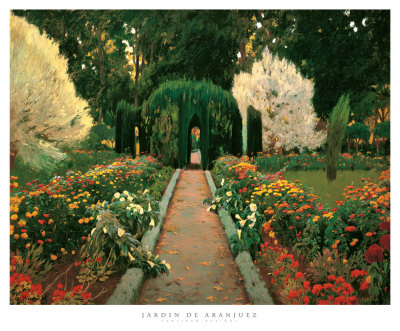
But I was reminded of it recently when I came across this picture, Jardí d’Aranjuez (Glorieta II) by Santiago Rusiñol:

It occurred to me that Aranjuez is an actual place, not just some name cited in a song. So I Googled some more pictures and was enchanted:


Aranjuez, it turns out, is a city near Madrid. It was built by the royal family in the 16th century as their spring residence and is a UNESCO world heritage site. It is a fairyland of royal palaces and spectacular gardens with ornate fountains and picturesque riverside walks. The rich, fertile land yields fat, juicy tomatoes, giant asparagus and luscious strawberries. Every spring, the Tren de la Fresa (Strawberry Train) runs along the historic route from Madrid to Aranjuez, and every passenger is given a plate of strawberries to eat en route.

The locals are enamoured of their city. Blogs rave about the fusion of history and modern lifestyle. Children grow up happy in Aranjuez, say the residents, and retired people have an abundance of quiet places to walk or sit in. It has been the set of numerous films. People who have spent their lives moving from city to city stop when they get there, and put down roots, captivated by its charms. It truly appears to be a golden paradise.


I started obsessing over Aranjuez. I spent hours looking at pictures of its gardens; I read every forum and resident’s blog I could find. Since I was in Spain at the time, I even started looking at trains to go there for a weekend.

But before I went ahead and organised a trip, I decided to go on a virtual visit courtesy of Google Street View. I put the little yellow man down in the city centre and waited for Aranjuez to load.

Aranjuez loaded. Aranjuez looked like an abandoned industrial estate.

“Perhaps I’ve just landed in an unfortunate place,” I thought, and moved the yellow man to a garden, but had no better luck there. The garden was surrounded by a high, solid grey wall and you couldn’t see any of it. I tried another street, and it was just more drab ghost town.

Everything looked dry, blindingly bright and scorchingly hot. There were no cars on the road, and there were hardly any people.
“These pictures were probably taken in the summer in the middle of the afternoon, when everyone was inside to escape from the heat,” I told myself.
But then I saw that the few people that were out and about were wearing long sleeves, so it couldn’t have been that summery.

I did the Street View tour of the length and breadth of the town and found no fountains, no gardens (except those hidden behind giant walls) and barely any signs of life, only anonymous-looking blocks of flats, factory loading bays, and some workers emptying a row of recycling bins.


There were some pretty parts of the city, to be sure, but it was all just so eerie


In fact, when you go back and look at the Google search results properly, you see the cracks appearing. Although the locals do love it (probably the parts of it behind the big walls, though), all is not rosy. The first discordant note sounds in the form of an article by a resident, entitled The Price of Living in Aranjuez. It is a privilege to live there, he concedes, but the problem is that everyone wants a piece of it. Every morning, the buses and trains are packed with commuters, and the central station groans under the weight of the people passing through it.

And the more you look, the more you find. The city is expanding too quickly. More and more people are moving there, but the infrastructure is not developing fast enough to accommodate them. The charm of the city is spoilt by extensive building works, while many of the older residential buildings are left to fall into a state of disrepair. A lot of residents prefer to work in Madrid. “Aranjuez = dormitory town!” declares one resident on a forum.

I suppose the lesson learnt is that paradise doesn’t exist, and also that residents have insights that tourists might miss or ignore. I should have known, I suppose.